Technology
Music usually travels one way, as sound, which leaves out anyone who cannot hear it. These tools carry it other ways instead: as light, as color, and as vibration you feel in your chest. Not one of them is a plan or a prototype. They are in classrooms and on stages now.
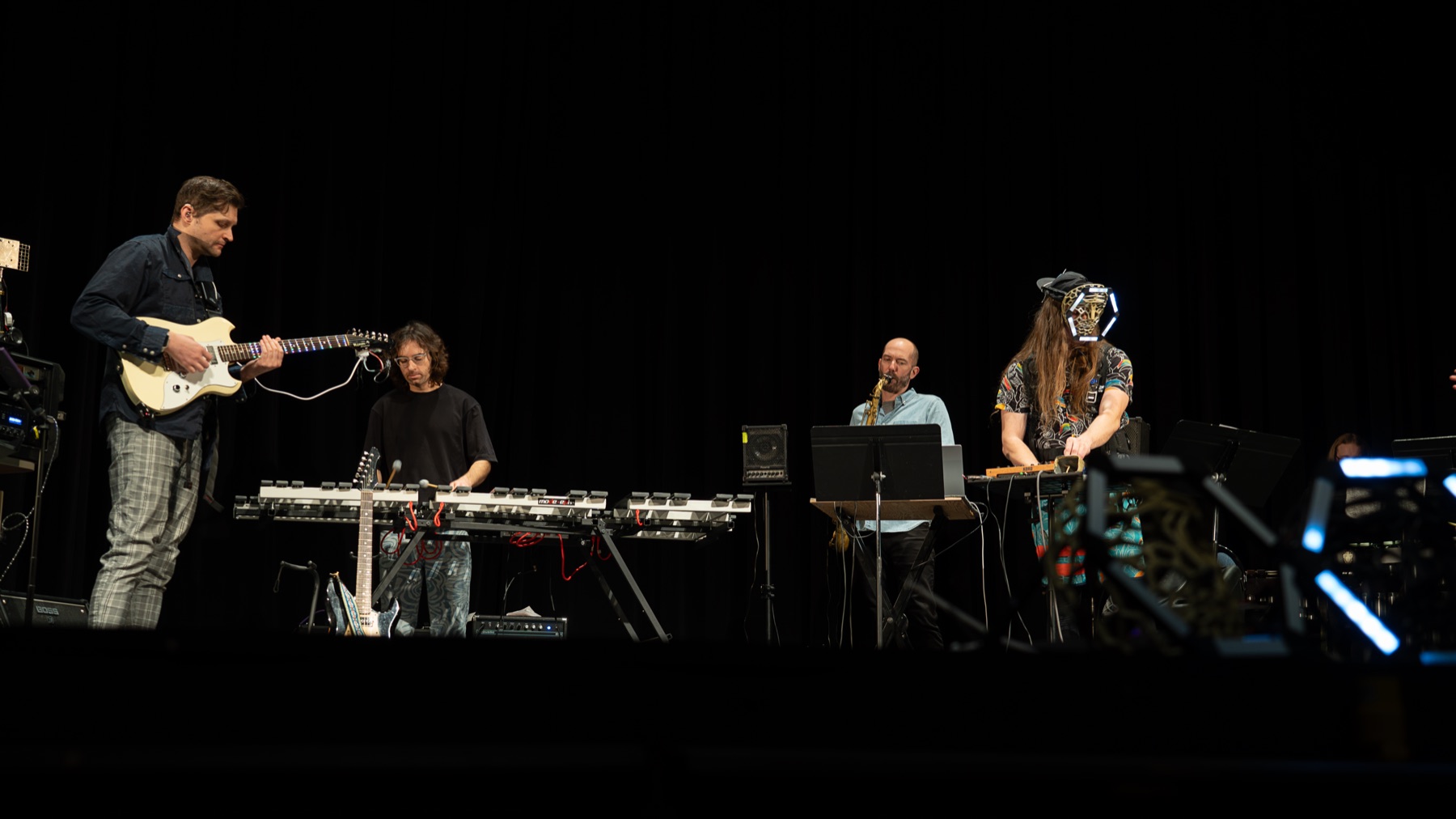
Deaf and hearing musicians performing together at Western Oregon University, December 2024.
Audiolux
Turns sound into synchronized light and color so music can be seen and followed without hearing it. Audiolux Jam puts the same color language on a screen, letting people play together and follow each other visually.
This is the tool behind the school workshops: pitch and rhythm become color and movement, and instruction runs in ASL and English together.
https://jam.audiolux.appPixelboop
An iOS app, on the App Store today, that renders every note as color on a grid. No notation and no theory required, which makes it a way into music for people the conventional route leaves out.
Current partnership: the Portland Jazz Composers Ensemble, a twelve-piece jazz chamber orchestra, working toward a Deaf-led jazz concert in 2027. A joint Oregon Arts Commission proposal was filed in August 2026.
https://www.pixelboop.com https://www.pixelboop.com/pjce.htmlWearable haptics for live music
Haptic vests carry music to the body as vibration, so a room of Deaf and hearing people share one performance. Up to thirty vests have been distributed at a single event, alongside ASL interpretation and audio-reactive visuals.
Case study: Deaf jazz workshops at Southern Oregon University →
Disability-led production lab
During the COVID period Myles ran a disability-led virtual production lab, coordinating accessible video productions with partner organizations and Deaf artists. Captioning, interpretation and visual design were built into the production pipeline rather than added afterward.
Productions from that period are published on the CymaSpace YouTube channel. Individual case studies are being written up as records are confirmed.
The tools in the room
Select any photo to open the slideshow
Who builds it
The tools are designed and built by de Bastion, Inc., a for-profit technology studio owned by Helpful Tech's founder, and licensed to Helpful Tech non-exclusively. Charitable money stays in the nonprofit; commercial activity stays in the studio. The arrangement is written down, and any transaction between them is made at arm's length with the interested party recused.
https://inc.debastion.comLooking for accessibility services rather than technology? See Accessibility.